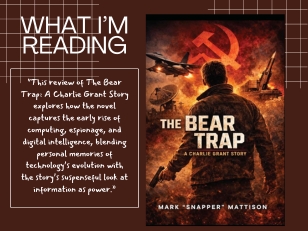
The Bear Trap is a techno-thriller by Mark “SNapper” Mattison. Set during the formative years of computer technology, blending espionage, technology, and suspense, it centers on Charlie Grant, a systems analyst navigating the crossroads of emerging computer power and intelligence operations. The book’s genre sits at the intersection of techno-thriller and historical fiction.
Some books are just entertaining, while others bring back memories you thought you had forgotten.
For me, The Bear Trap: A Charlie Grant Story is one of those books that makes me reflect on my own past.
I see this story through the lens of someone who lived during the years it describes. Back then, computing wasn’t yet an industry, ‘cybersecurity’ wasn’t a known field, and the idea of machines shaping world events was still just a theory.
Years spent writing for publications like BYTE, ComputerWorld, Network World, and PC World showed me computing’s shift from isolated mainframes to interconnected infrastructures—systems that quietly began shaping intelligence operations. I remember sitting in a classroom in the late 1980s, watching an IT manager haul a DEC terminal onto a wheeled cart, connecting our office to a wider corporate network for the very first time. There was this brief moment when a colleague received an unexpected message, some cryptic text from another campus across the state, that made us all realize how easily information could travel, for better or worse. That was the first day I grasped that interconnectedness wasn’t just a technical advance; it was a fundamental change in how knowledge and power could move. The Bear Trap makes me realize these changes weren’t just technical milestones; they were the beginning of digital power.
It feels like a memory that’s become clearer and more vivid.
A Story That Understands the Birth of Digital Power
In its depiction of Charlie Grant, The Bear Trap places him in a world where computing power is still tangible—reels of tape, punch cards, analog terminals humming in dim rooms. However, the story transitions to a more abstract concept: intelligence networks and signal interception that extend beyond human oversight.
The story conveys this period’s ambiguity well. You’re not yet in ‘cybersecurity’ as defined now—you’re in something messier: systems built for calculation repurposed for surveillance.
- Human analysts are struggling to make sense of what the machines are producing.
- Governments are realizing that information itself is a strategic weapon.
That tension is at the heart of the story.
Throughout my career, I wrote about how computing systems evolved from simple tools to infrastructure and, eventually, to systems of control.
My Perspective: Growing Up Around the Edge of the Machine
When I was a kid, I saw terminals, early PCs, bulletin boards, and the first hints that networks could let information slip out without control.
There was a certain feeling back then, which The Bear Trap captures well: the people creating these systems were always a step behind the consequences of their work.
Adults called it ‘data processing’ or ‘information systems,’ but anyone paying close attention could see that something bigger was taking shape.
Reading about Charlie Grant’s world brought that feeling right back—the sense that the foundations of intelligence were being built as they went, with no clear plan.
Charlie Grant as a Narrative Anchor
Charlie isn’t a modern hacker. He’s more like the early cryptographers and systems analysts who worked with math and national security. In many ways, he reminds me of real figures like Whitfield Diffie or Clifford Cocks, people who helped pioneer cryptography and secure communications before the field became part of everyday conversation. There’s also a resemblance to analysts such as Margaret Hamilton, who developed the early systems that kept missions safe, or the codebreakers at Bletchley Park, who used analytical thinking and rudimentary computing to untangle enemy secrets. Charlie Grant seems to sit at this crossroads, shaped by the shadowy, hands-on atmosphere that defined this era.
He belongs to a very specific time in technology:
- When computation was still expensive and centralized
- When “real-time” analysis meant minutes or hours, not milliseconds
- When human interpretation still mattered more than automation
From a writing perspective, that restraint is what makes the story believable. It doesn’t try to update the past; instead, it respects what was possible at the time.
Too many stories about technology rewrite history by adding modern abilities. The Bear Trap avoids this and stays true to what systems could and couldn’t do at the time.
The Cybersecurity Lens Before Cybersecurity Existed
As someone who later worked in technology journalism, I find it fascinating to look back at the early days of cybersecurity, before we even had the language for it.
Today, we have formalized terms:
- intrusion detection systems
- threat intelligence
- encrypted communications
- network security architecture
In Charlie’s world, these security ideas are just starting to appear as gut feelings, not as formal rules. Security isn’t a framework yet; it’s still just a reaction.
That’s exactly why the story feels so true to its time. It shows an era when security wasn’t built in from the start, but was added later after breaches, leaks, and the first signs that machines could be vulnerable.
Final Thoughts
The Bear Trap doesn’t make digital intelligence seem glamorous. Instead, it shows how unstable and powerful these systems were, and how their creators only partly understood what they were making. The story’s main point is clear: as computers became more important, information turned into a real weapon, and we’re still seeing the effects today. You only have to look at recent headlines: ransomware attacks disrupting critical infrastructure, social media manipulation influencing elections, or breaches exposing sensitive data across industries. Each of these incidents echoes the book’s central idea—that our reliance on digital systems has made information both a tool and a threat. The world Charlie Grant navigates feels surprisingly familiar because of these challenges of today, telling us that the foundations of digital intelligence still shape the risks and power struggles of today.
For me, the story is a reflection on how people slowly realized that computing would become a source of power. It shows the gradual, sometimes uncertain shift from simple tools to infrastructure—a shift I experienced and wrote about as it happened.
While reading, I found myself thinking less about the story as fiction and more about how these systems were all connected. The systems I wrote about weren’t isolated; they were the building blocks of a bigger change. The Bear Trap reminds me of that ongoing move toward digital intelligence.
We didn’t “enter” the digital intelligence age.
We built the digital intelligence age step by step, without really knowing what it would become.
The Bear Trap captures the incremental, often unrecognized build-up of digital intelligence. It addresses the ongoing transformation, making clear that each piece set the stage for today’s power dynamics.
That’s why the story stuck with me long after I finished reading.
Leave a Reply